Bayesian Trend
26th December 2025

| Mode | Sample | Prob | Learn Rate | Post Var |
|---|---|---|---|---|
| P(Win | +, Long) | 9 | 67% | 8.3% | 1.71% |
| P(Win | +, Short) | 11 | 55% | 7.4% | 1.71% |
| P(Win | -, Long) | 6 | 88% | 12.5% | 1.22% |
| P(Win | -, Short) | 3 | 40% | 20% | 4% |
About This Script
This script uses Bayesian probability theory to dynamically assess market trends by continuously updating its beliefs as new price data arrives. To be precise, the script uses Bayes' Theorem, a mathematical framework that describes how to revise probability estimates when presented with new evidence (a new trade).
Bayes' Theorem works by combining two elements: a prior belief (set at 50%) and the likelihood (how well the new data supports different hypotheses). The result is a posterior belief, an updated probability that incorporates both your starting assumptions and the fresh market information.
Eli5: If the trade is a winner, it updates the state using the Bayesian updating formula. The higher the probability of a mode, the greater the likelihood of the trade succeeding.
How To Use
There are multiple ways to interpret and trade the Bayesian Trend.
Length:
- Self-Tuning: Uses the best length for the timeframe
- Absolute: Finds the absolute trend length (trades less frequently but may lag)
- Manual Length: Manually enter the trend length you like
Trading Styles:
- Simply: You can simply long and short the signals or the trades near the trend
- Using probability: You can use both the signals and the probabilities as well as probability too
But before you use the probability table, you must understand the modes:
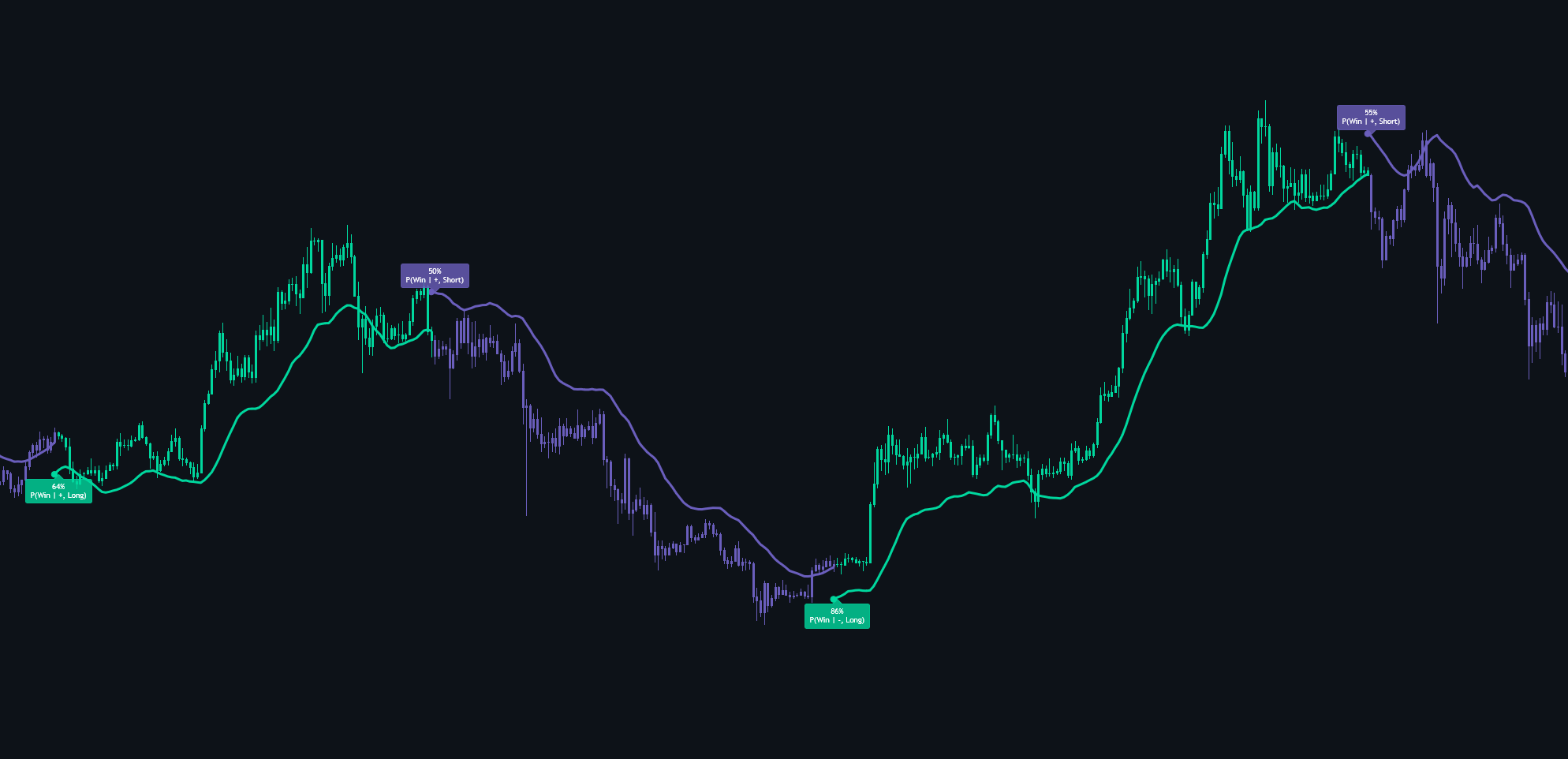
- P(Win | +, Long): Uptrend longs
- P(Win | +, Short): Uptrend shorts
- P(Win | -, Long): Downtrend longs
- P(Win | -, Short): Downtrend Shorts
Example: 55% P(Win | +, Long) means the script has been doing very well at capturing the trend. Thus, there's a better than even chance for the trade to be profitable (if long, close > entry).
Bayesian Probability Table:
- Sample Size: The number of trades used to evaluate the current trend
- Probability: The estimated likelihood of trade working out based on previous successes for the mode
- Learning Rate: To assess if the script is stabilising
- Posterior Variance: The statistical confidence in probability estimates