LLNR
13th January 2026

Overview
The Eclipse LLNR, Log-Likelihood N-Rho oscillator is a ratio of 2 components. Rho is a proprietary calculation of a signal that is differenced (force time series stationary, allowing for more predictability) and its relation to a unit of a measure of noise. N is the amount of times it is differenced. N here is permanently 1.
Using a simplified q-learning reinforcement learning agent, the length of the ratio is calibrated to its optimal value. The input length relates to how many bars it should look back for the current bar's calculation.
Calculation of Eclipse LLNR
Rho (ρ) is a proprietary signal derived from price (or another input series). Rather than operating on the raw signal, Rho is differenced (meaning consecutive values are subtracted from one another) to remove trends and force the time series toward stationarity. A stationary series has a consistent mean and variance over time, which is a prerequisite for many statistical and predictive methods to work reliably. In essence, differencing strips away the drift in price so that what remains is more structurally predictable noise-adjusted movement.
N is the order of differencing: how many times the differencing operation is applied. First-order differencing (N=1) removes a linear trend. Second-order differencing (N=2) removes acceleration or curvature in the series. Higher values of N progressively remove deeper-seated non-stationarity, though over-differencing can introduce its own distortions, so N is not arbitrary.
Log-Likelihood refers to the statistical framework used to evaluate how well a given model or parameter set describes the observed data. In the context of LLNR, the log-likelihood is used as a fitness criterion.
How To Use
There are 2 ways to trade it.
Method 1: Trading the long/short signals
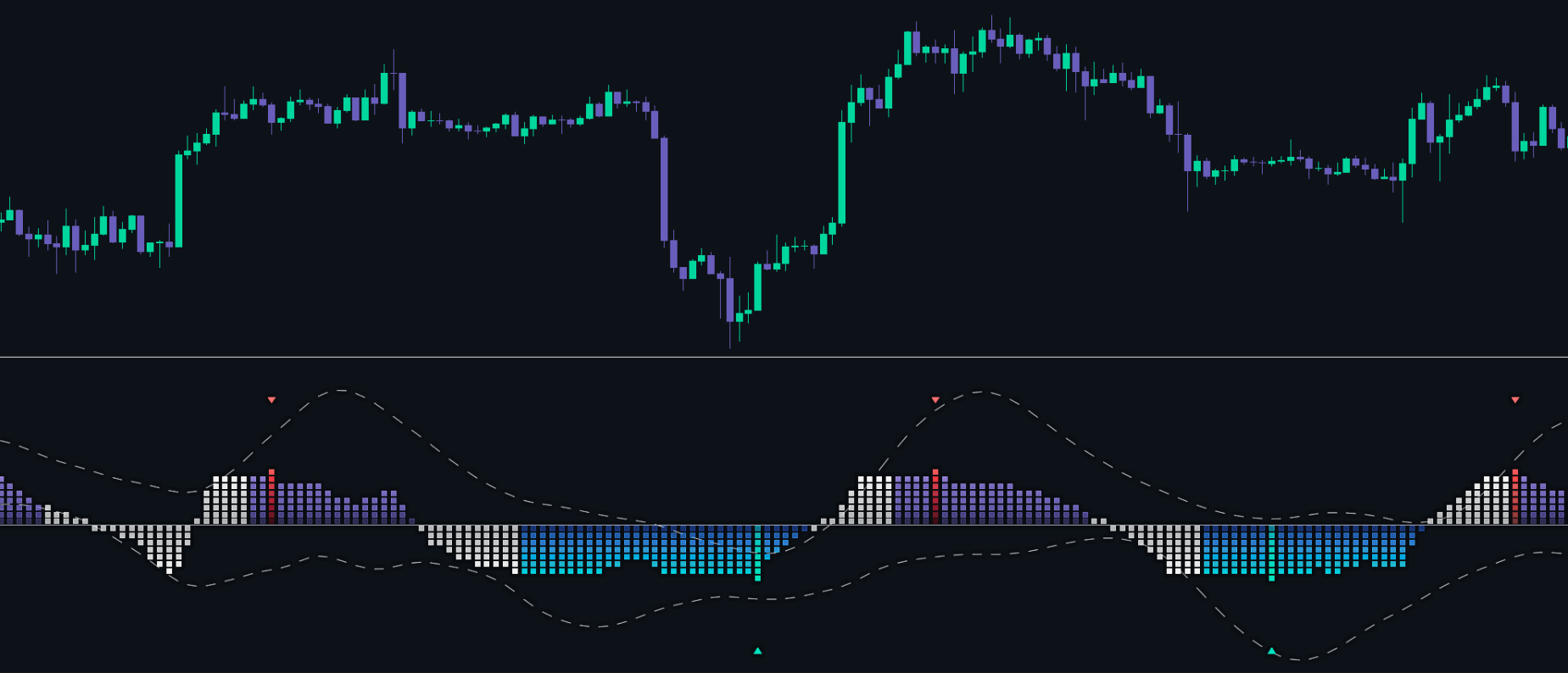
You can simply trade the long/short arrows as it fits your system.
Method 2: Understanding LLNR stability
The more there are blue plots before a bullish signal (and purple for a bearish signal), the more unstable it is (as per the RMSE bands).
- Blue highlights: High RMSE values for bullish signals. Excessive or prolonged RMSE values before a bullish signal may make it unstable
- Purple highlights: High RMSE values for bearish signals. Excessive or prolonged RMSE values before a bearish signal may make it unstable
- Even if unstable, they're still tradeable. But this will allow you to determine which signals are stronger than others
- If you wish to trade with stability, better to stick with signals that have 3-4 at most RMSE highlights (blue or purple plots). Note: they will be considerably rarer
Final Notes
- If you have a light background by default (such as white), select 'Light' theme in the 'Appearance Settings'